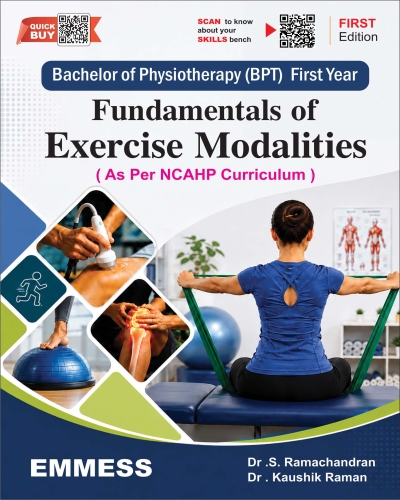
This book was written in the clinic as much as at the desk. Its organisation, its choice of topics, and the depth at which each is treated all reflect what a first-year BPT student genuinely needs to know — not everything that could be said about exercise therapy, but precisely what equips a student to participate confidently in practical classes, pass the written and practical examinations, and begin supervised clinical placement with a firm conceptual foundation. The subject of this volume is Fundamentals of Exercise Modalities, Course BPT 104, as defined in the curriculum approved by the National Commission for Allied and Healthcare Professions (NCAHP), and it is structured in two parallel streams — theory and practical — that mirror the organisation of the course itself: the theory chapters provide the physiological, anatomical, and clinical reasoning that underpins each technique, while the practical chapters translate that reasoning into a hands-on, step-by-step format that follows the student from the first observation of a technique through to the recording and interpretation of findings.
The coverage is comprehensive within the syllabus but deliberately does not reach beyond it, for the aim here is not an encyclopaedic reference but a textbook meant to be read, studied with, and returned to during preparation for assessment. For the student, each chapter opens with clearly stated learning objectives, is written in plain, precise British English with technical terms defined where they first appear, uses colour-coded callout boxes to flag material most likely to appear in MCQs, viva questions, and OSPEs, and places original illustrations exactly where they are needed rather than gathered separately at the end, with every figure captioned to explain what it demonstrates rather than merely label it; the review questions closing each chapter — multiple-choice questions with an answer key, short-answer questions, viva topics, and, in the practical chapters, a worked example with an OSPE checklist — are not afterthoughts but a structured revision tool meant to be used throughout the course.
 Download Table of Content
 Download Sample Chapters